FORT
TUTHILL
MILITARY
MUSEUM
Bringing Arizona's Military History Alive. Preserving the distinguished legacy of the 158th Infantry Regiment — the legendary "Bushmasters."
Upcoming Openings: Museum opening is dependent on the availability of volunteer staff. Check back frequently!
Visit Fort Tuthill Military Museum
Located in the cool pines of Flagstaff, Arizona. We advise you check our schedule or call ahead to ensure the museum will be open on the day you plan to visit.
Museum Hours
No openings scheduled yet. Check back soon or call ahead.
Location & Contact
Fort Tuthill Coconino County Fairgrounds
2446 Fort Tuthill Loop Rd.
Flagstaff, AZ 86004
Admission is free. Donations welcome.
Museum Raffle
No current raffles at this time. Donations needed!
What Visitors Are Saying

"Wonderful display, well presented and very well documented."
Sylvia
Phoenix, AZ
"One of the most fantastic military displays ever in a relatively small museum."
Frank — Col Retired
Prescott, AZ
"Served in Desert Storm — Great Job on the museum."
Jeff — Maj US Army Retired
Gilbert, AZ
"This is a must see while in Flagstaff. The displays of the history of the 158th Battalion are excellent along with the volunteers."
Robin Berry
Arizona
158th Infantry Regiment
The 158th Infantry regiment traces its origin to the First Regiment of Arizona Volunteers organized in 1865. The unit, comprised of Mexican Americans and members of the Pima and Maricopa Indian tribes, was equipped with hand-me-down uniforms and weapons and generally poorly treated by other military units. However, they proved effective in their several campaigns. Unfortunately, neither the soldiers nor officers were paid, and the unit was disbanded after some eighteen months in the field. In 1877, the regiment was designated as the First Arizona Infantry and continued to provide security to citizens of the territory. Ten regiment officers and 117 enlisted men volunteered in April 1898 to join Teddy Roosevelt's Rough Riders. The Arizona Unit, known as the 1st Volunteer Cavalry, commanded by Col A. O. Brodie, consisted of two companies commanded by Captains Buckeye O'Neill and James McLintock. A sniper killed the colorful Captain O'Neil during the Battle of Santiago. Captain McClintock was seriously wounded and later served as Colonel commanding the 1st Arizona Infantry Regiment. Col. Brodie was appointed Governor of the Arizona Territory in 1902.

On May 9, 1916, as a result of raids on American Border towns by the Mexican Revolutionary Pancho Villa, the First Arizona Infantry was called into Federal service, serving as part of U.S. Forces stationed on the Mexican Border under the command of General John J. Pershing. Designated the 158th Infantry Regiment on August 3, 1917, the regiment served in France during WW I as part of the 40th Infantry Division. While in France, the 158th was selected as the Honor Guard for President Woodrow Wilson during the Paris Peace Conference. The Regimental Band was also designated as the President's Honor Band.
From 1929 to 1937, again in 1939, and for the last time in 1948, the regiment trained at its permanent field training site, Fort Tuthill, outside Flagstaff, Arizona. The facility's location in the pine-covered forests of Northern Arizona allowed the regiment to meet training objectives not possible in the heat of the Arizona desert. As a result, when mobilized, the officers and non-commissioned officer staff were well prepared to meet the accelerated training objectives associated with preparation for combat, including the challenges involved with integrating replacements necessary to bring the regiment to full combat strength.
From 1929 to 1937, again in 1939, and for the last time in 1948, the regiment trained at its permanent field training site, Fort Tuthill, outside Flagstaff, Arizona.
During training at Fort Sill, Oklahoma, and Camp Barkley, Texas, the 158th was one of four infantry regiments making up the 45th Infantry Division. In 1941, the Army Division was restructured from the Square, or four-regiment model, to the triangular, or three-regiment concept, and the 158th was removed from the 45th Division.
In December 1941, the regiment embarked on a trip to Panama. Its mission was to train in jungle warfare and assist in Canal Zone defense. The distinctive shoulder patch of the 158th Regimental Combat Team depicting the Bushmaster snake coiled around a jungle machete would later evolve from this Panama training experience. Due to their specialized jungle training, General Macarthur requested the regiment be sent to the Southwest Pacific Theater. The regiment, along with the 147th Field Artillery Battalion South Dakota National Guard and supporting units operating as the 158th Regimental Combat Team, "Bushmasters," compiled one of the distinguished combat records in World War II. Often relieved by entire divisions as they moved on to their next objective, the Bushmaster's major campaigns included:
- ▪December 1944 — Arawe, New Britain Island.
- ▪May 1944 — Wakde Island-Sarmi New Guinea opposed by crack 36th Tiger Division relieved by the 6th Infantry Division.
- ▪July 1944 — Amphibious assault Noemfoor Island, New Guinea.
- ▪January 1945 — Amphibious assault Lingayan Philippine Islands relieved by 33rd Infantry Division.
- ▪March 1945 — Batangas Province, Southern Luzon, Philippine Islands relieved by 11th Airborne Division.
- ▪April 1945 — Amphibious assault Legaspi Southern Luzon, Philippine Islands.
- ▪April 1945 — Amphibious assault Bacon, Sorsogen Province Philippine Islands.
- ▪April 1945 — Camalig, Cituinan Hill mass, Luzon Province, Philippine Islands.
- ▪May 1945 — Mt Isarog Bicol Peninsula, Philippine Islands.
As a result of its outstanding record, the combat team, along with the 40th Infantry Division, was selected to spearhead the invasion of Japan four days before X-Day. The 158th mission was to silence Japanese Air warning stations on the island of Tangashima off the Japanese coast. Army Headquarters advised the Bushmasters to expect casualties as high as 75%. Japan's surrender eliminated the need for this high-risk operation. On October 1, 1945, the 158th Regimental Combat Team sailed for Yokohama and its final mission as part of the U.S. Occupation Forces. General Hanford McNider, the combat team commander, described his Bushmasters as "One of the most fighting little armies in anybody's history." Tokyo Rose called them "The Butchers of the Pacific." The 158th Regimental Combat Team will be remembered and respected as one of the outstanding fighting organizations of WW II.

"The 158th Regimental Combat Team wrote the book on 'Jungle Warfare' with its own blood. Any history written about the war in the Pacific would be incomplete if it failed to mention the many military exploits of the 'Bushmasters.' You have set records that will never be broken."
Bushmaster Henry Seabald, addressing a post-war Bushmaster convention, listed the following Bushmaster accomplishments. The 158th served five and one-half years on active duty and was:
- ▪Continuously in a combat zone longer than any National Guard unit in all U.S. wars.
- ▪The first Army unit trained in jungle warfare — established the Jungle Warfare School.
- ▪The first Army unit to be sent overseas after Pearl Harbor.
- ▪The organization traveled further in their 5½ years of active duty than any Army unit in any war.
"You were selected as one of the units to spearhead the invasion of Japan, landing four days before the main invasion force on a small island off Kyushu to silence Japanese early warning stations. You defeated the Japanese, who had never been defeated in modern history. It is my pleasure to salute you, Bushmasters, for a job well done."

Although initially alerted for possible mobilization, the regiment did not see service during the Korean War. However, many officers and men from the regiment and other units volunteered for service during that conflict. On December 17, 1947, due to the restructuring of Army National Guard units, the 158th Infantry Regiment's 102-year history ended. During ceremonies on the football field at Phoenix Junior College, former regiment members watched as the Regimental Colors were retired and the regiment passed in review for the last time.
However, this event was not the last chapter in the Regiment's storied history. In 2005, the Department of the Army authorized one Battalion of the Arizona Guard to carry the designation First Battalion 158th Infantry. On September 17, 2006, thirty-eight years after the colors were retired, a review was held at Arizona National Guard Headquarters, "Bushmaster Field." There, soldiers of the new First Battalion 158th unfurled their colors and campaign streamers and paraded, marking the continuation of the 158th distinguished heritage and tradition. Battalion soldiers are authorized to wear the distinctive 158th Regimental Crest depicting a desert Gila monster on a blue shield over the Spanish word "Cuidado." The unit continues to operate as 1st Battalion 158th Bushmasters.
The Battalion was mobilized for service in Afghanistan in January 2007, returning to home station in March 2008. During combat operations, Staff Sergeant Charles Browning and PFC Mykel Miller, brave soldiers of the Battalion, made the ultimate sacrifice. Twenty-four of the Battalion's soldiers were wounded in action, demonstrating their courage and dedication. The unit, as part of the 29th Brigade Combat Team, continues its training to assure the 158th Infantry will be prepared to serve their country wherever the "Bushmasters" may be needed.
The 2005 museum opening featured a ceremonial transfer of the Regimental Colors from WW II regiment members to the Battalion Commander and Command Sgt Major of the newly formed 1st Battalion 158th Infantry Regiment. The ceremony signified the passing of the distinguished history and tradition of the famous regiment to the 1st Battalion. The museum ensures that the 150-year-old history of the 158th Infantry Regiment and its past and present soldiers continue to be preserved.
About Fort Tuthill Military Museum
The Fort Tuthill Military Museum is dedicated to preserving, interpreting, and sharing the rich military history of Arizona, with a particular focus on the 158th Infantry Regiment. Through engaging exhibits and educational programs, we honor the sacrifices and contributions of those who have served, inspiring future generations and fostering a deeper understanding of our nation's heritage.

Constructed in 1929 and named after General Alexander M. Tuthill, Fort Tuthill was considered one of the finest National Guard training facilities in the United States. Located three miles south of Flagstaff, Arizona.
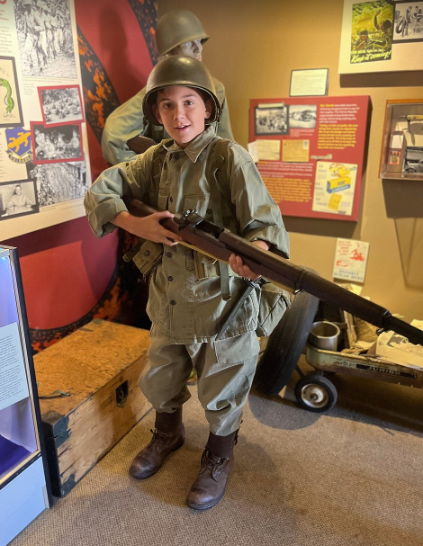
Housed in two of Fort Tuthill's original buildings, the museum presents the appearance of a Regimental Headquarters Building of the 1940's. Exhibits trace the history of the regiment from its organization in 1865 to the 2005 organization and Afghanistan deployment of 1st Battalion 158th Infantry.
What Visitors Are Saying
"This was such a nice museum! Very clean and set up very well! The manager James is very kind and knowledgeable!"
— Hannah B, Tripadvisor
"The museum was very interesting and the guide James was excellent. He took the time to answer any questions."
— Steve B, Tripadvisor
"Very rich history. Amazing guide and folks helping understand the history. The timeline is very easy to follow."
— Jay K, Tripadvisor
"Museum is filled with priceless US history. Tour received was informative to say the least."
— Mark G, Tripadvisor
"I took my youth group to visit the Museum. The tour was great. Very informative on Arizona Military service."
— Kevin R, Tripadvisor